mechanical-engineering-skills
Tutorial: LLM-SR equation discovery (data → interpretable law that extrapolates)
Skill: equation-discovery · Papers: P. Shojaee, K. Meidani, S. Gupta, A. Barati Farimani, C.K. Reddy, LLM-SR: Scientific Equation Discovery via Programming with Large Language Models, ICLR 2025 (Oral), arXiv:2404.18400; P. Shojaee, N.H. Nguyen, K. Meidani, A. Barati Farimani, K.D. Doan, C.K. Reddy, LLM-SRBench, ICML 2025, arXiv:2504.10415 · Code: deep-symbolic-mathematics/LLM-SR
Symbolic regression usually searches blind over operators. LLM-SR lets an LLM write equation skeletons as programs, guided by what it knows about the physics: saturation, damping, Arrhenius, power laws. An optimizer fits the constants, and the best programs come back as examples for the next proposal.
In this skill Claude proposes and eqdisc.py fits, scores and remembers.
Use cases
- Constitutive laws from test data: stress–strain–temperature, creep, fatigue.
- Process correlations for manufacturing: melt-pool size, surface roughness, tool wear.
- Replacing black-box fits when you need to extrapolate, or to explain the model to a reviewer.
- Benchmarking on the LLM-SR problems or LLM-SRBench.
Setup
npx skills add BaratiLab/mechanical-engineering-skills --skill equation-discovery
pip install numpy scipy pandas scikit-learn matplotlib
cd skills/equation-discovery
Walkthrough: aluminium stress–strain across temperature (LLM-SR’s stressstrain)
python scripts/eqdisc.py fetch --problem stressstrain --dir ss/
python scripts/eqdisc.py baseline --dir ss/
The baselines, as NMSE on train / validation (in-domain test) / held-out temperature:
- linear: 0.380 / 0.377 / 1.31
- cubic polynomial: 0.161 / 0.150 / 0.680
The held-out split is one temperature (0.667) that isn’t in the training set but lies inside the training range (0.067–1.0). It tests generalization to an unseen condition by interpolation, not extrapolation; hold out the hottest condition if you need to test extrapolation.
Looking at slices of the data: stress rises steeply, saturates, and drops at large strain (necking),
and the plateau falls with temperature. The proposals, scored with
eval --dir ss/ --src '...' --note '...':
| # | Idea | Params | NMSE (train / validation / held-out T) |
|---|---|---|---|
| 2 | Voce saturation σ_sat(T)·(1 − e^(−kε)), σ_sat linear in T |
3 | 0.095 / 0.107 / 0.549 |
| 3 | + necking −p·ε^n |
5 | failed: ε < 0 in the data gives NaN, so use np.abs |
| 4 | + softening that scales with T | 6 | 0.058 / 0.068 / 0.269 |
| 5 | + quadratic thermal softening, T-dependent stiffness | 8 | 0.021 / 0.025 / 0.074 |
python scripts/eqdisc.py prompt --dir ss/ --k 3      # the LLM-SR-style prompt for proposal #6
python scripts/eqdisc.py pareto --dir ss/ --out front.png
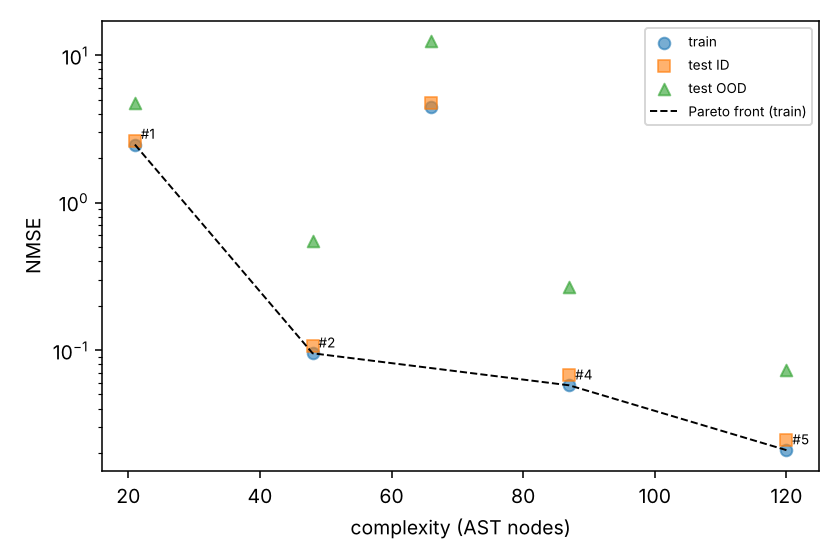
The final law has 8 constants and is 9× more accurate than the cubic polynomial at the unseen temperature (0.074 vs 0.680). Every term has a physical reading: elastic stiffness, a saturation stress that falls with temperature, and necking softening.
Rules
- Change one idea per proposal and write why in
--note. The buffer becomes your lab notebook. - Choose from the Pareto front by validation error and simplicity, not by train error alone.
- Keep the final test untouched while searching:
eval,prompt,topandparetohide it. Runfinal --id Nonce, on the equation you have frozen. - This walkthrough shows held-out scores at every step for teaching. The skill now hides them during a real search, so these numbers come from a replay, not from a blind test.
- Skeletons run in an isolated subprocess with numpy only and a time limit.
Cite: Shojaee et al., ICLR 2025; Shojaee et al., ICML 2025.