mechanical-engineering-skills
Tutorial: LinkD (target curve → planar linkage)
Skill: linkage-synthesis · Paper: LinkD: Autoregressive diffusion for mechanical linkage synthesis, Barati Farimani Lab, arXiv:2601.04054
LinkD designs one-degree-of-freedom planar linkages whose end-effector traces a target curve.
How it represents a mechanism:
- Each mechanism is an N × 24 graph matrix. Every row holds a node’s validity flag, its type (fixed, revolute or crank pad), its normalized x and y, and 20 lower-triangular adjacency entries. N is at most 20.
- A trained diffusion model builds the graph one node at a time.
- Each new node must attach to exactly two known nodes, which makes it a dyad.
How each proposal is checked:
- The kinematics are simulated over 200 crank angles.
- If the law of cosines has no solution at some angle (|cos φ| > 1), that is a branch defect, and the node is resampled. Up to K = 25 retries are allowed per node.
Success rates in the paper:
| Retry strategy | Success rate |
|---|---|
| One-shot | 29.4% |
| Graph-level retry | 96.7% |
| Node-level retry | 99.6% |
The paper does not release the trained weights. The skill therefore keeps the representation, the validation, the node-by-node construction with bounded retries, and the Chamfer metric exactly as published. In place of the diffusion sampler, an optimizer proposes nodes: differential evolution, then Nelder–Mead. It also adds practicality limits (link ratio, pivot spacing, overall size), so a fit cannot come from a mechanism nobody could build.
Use cases
- Path generation: a gripper finger, a walking-robot foot, a film-advance claw, a pick-and-place arc, or a toy mechanism that must follow a drawn curve.
- Six-bar upgrades: when the best four-bar can’t follow the shape, the skill adds one dyad at a time and keeps the addition only if the fit improves by more than 2%.
- Checking an existing linkage: verify it moves through the full rotation without locking, and measure how far the joints come from colliding.
- Datasets and research: encode and decode LinkD’s N×24 matrices, and score any generator with the paper’s Chamfer distance (raw or rotation-invariant).
- Teaching: coupler curves, Grashof behaviour, and why some links lock.
Setup
npx skills add BaratiLab/mechanical-engineering-skills --skill linkage-synthesis
pip install numpy scipy matplotlib
cd skills/linkage-synthesis
1. Check that it can recover a known mechanism
Simulate the example four-bar, then ask the synthesizer to find a mechanism for that curve without being told the answer:
python scripts/linkage.py validate examples/fourbar.json
python scripts/linkage.py simulate examples/fourbar.json --out fourbar_curve.csv
python scripts/synth.py fourbar_curve.csv --out recovered.json --max-nodes 5
The second four-bar attempt reached CD = 0.0002, meaning the recovered mechanism traces the same curve. Run this check whenever you change the code.
2. Synthesize for a shape a four-bar can’t follow
python scripts/synth.py --preset bean --out bean.json --max-nodes 7
python scripts/linkage.py plot bean.json --target bean_target.csv --out bean.png
The log shows the paper’s construction loop at work:
[four-bar] attempt 2: CD = 0.0526
[grow] 7 nodes: CD = 0.0497
[grow] no proposal improved the fit after 25 retries; stopping at 7 nodes
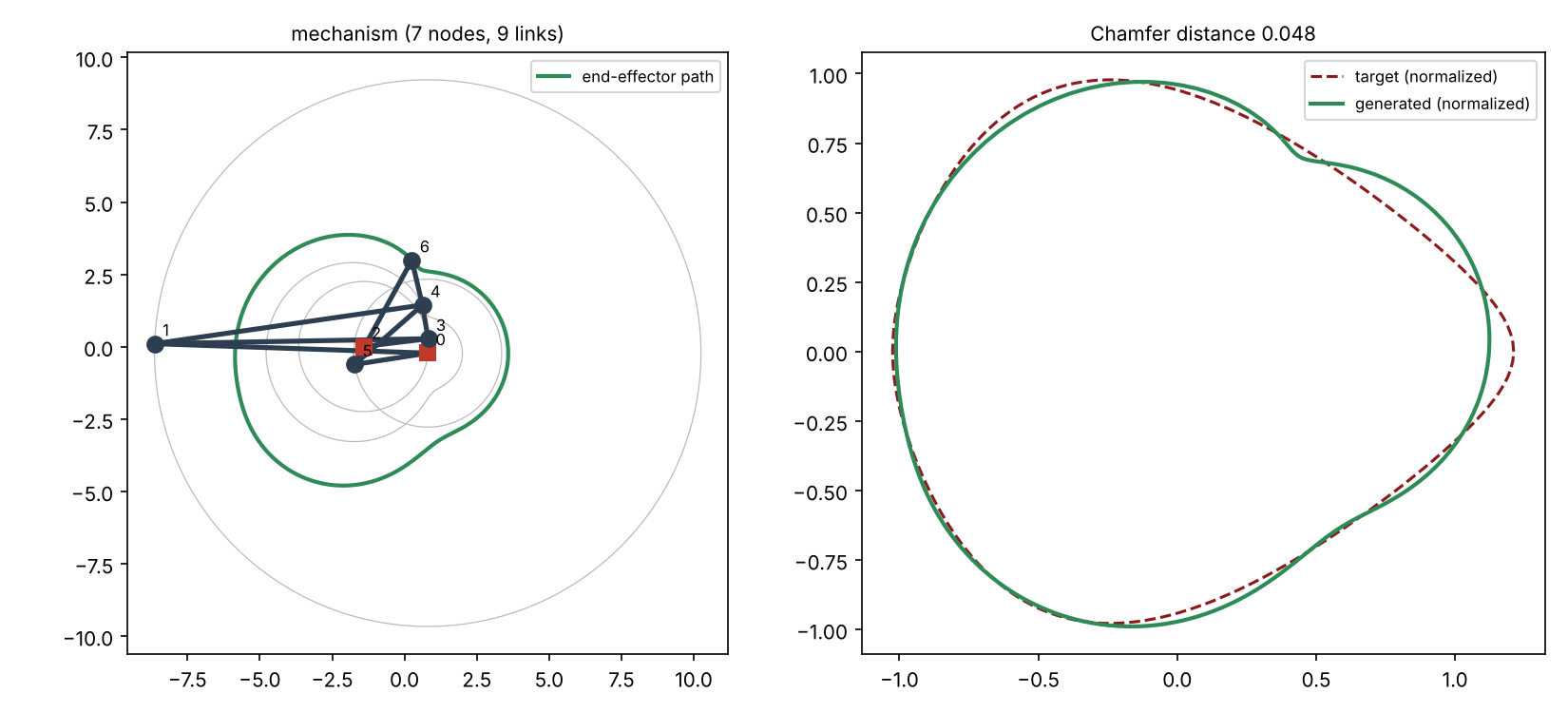
Result:
- A 7-node, 9-link six-bar with Chamfer distance 0.048 after arc-length resampling, or 0.047 if a rotated or mirrored installation is allowed.
- The validation pass found it topologically and kinematically valid through the full turn.
- Link-length drift was 1e-14.
- Practicality: link ratio 8.0, at the limit; smallest link 0.125 of the largest; ground pivots 0.24 apart.
The fit is good everywhere except the convex lobe on the right. That lobe is what the next dyad would have had to fix, and none of the 25 proposals improved it by more than 2%.
3. Read the numbers correctly
- Two Chamfer protocols. LinkD compares curves sampled at 200 equal crank angles (Eq. 7,
mean nearest-neighbour L2 in both directions). Applied to a target drawn by hand, that
scores even a perfect mechanism badly, because the crank does not move at constant arc
speed. The skill resamples by arc length for search and reporting.
compare --rawgives the paper’s protocol when both curves come from mechanisms. - For scale: the paper’s mean CD was 0.121, 0.145 and 0.188 under its three settings, measured on its own normalization.
- Invariance:
--invariantsearches 72 rotations and a reflection. Use it only if the mechanism may be installed rotated or mirrored.
4. Make it real
- Export the joint coordinates from
bean.json, scaled to your size, and check link thickness and clearances in CAD (seeparametric-part-cad). - Size the pins with
machine-element-sizing. linkage.py validatereports the minimum joint separation over the cycle. Keep it larger than the pin diameter.
Cite: LinkD, arXiv:2601.04054.