mechanical-engineering-skills
Tutorial: AdditiveLLM (L-PBF parameters → defect regime)
Skill: lpbf-defect-prediction · Paper: P. Pak, A. Barati Farimani, AdditiveLLM: Large language models predict defects in metals additive manufacturing, Additive Manufacturing Letters 14 (2025) 100292, doi:10.1016/j.addlet.2025.100292 · arXiv:2501.17784 · Data: MeltpoolNet (Akbari et al., Additive Manufacturing 55 (2022) 102817)
Laser powder bed fusion parts fail in three ways that show up in the melt pool:
- Keyholing: too deep a melt pool traps vapour pores.
- Lack of fusion: tracks or layers don’t overlap.
- Balling: a long melt pool breaks up into beads.
AdditiveLLM labelled MeltpoolNet’s measured melt pools with three geometric criteria. It then
augmented each melt pool over a 20 × 20 grid of hatch spacing and layer height, and
fine-tuned small LLMs on text such as
SS316L [SEP] 200 W [SEP] 800 mm/s [SEP] 80 microns [SEP] 100 microns [SEP] 30 microns.
The best model, Llama-3.2-1B, reached 94.2% exact-match accuracy.
This skill rebuilds the dataset from the public MeltpoolNet CSVs and trains a fast gradient-boosted model with physics monotonic constraints, for example that more power never makes keyholing less likely. It answers three questions:
- Do these melt-pool dimensions pass the criteria?
- What regime will these parameters give?
- Where is the safe window?
Use cases
- Screen parameters before a build: “Ti-6Al-4V, 280 W, 1200 mm/s, 100 µm hatch, 30 µm layer: will it keyhole?”
- Process windows: a power–velocity map for a fixed hatch and layer, with the most robust point marked and the measured data drawn on top.
- Interpreting single-track experiments: measured depth, width and length give an exact criteria verdict with the arithmetic shown.
- Planning a DOE: put density cubes around the robust point instead of sweeping the whole space.
- Fine-tuning an LLM as in the paper: the built dataset already has the Baseline text
column (see
references/finetune.md).
Setup
npx skills add BaratiLab/mechanical-engineering-skills --skill lpbf-defect-prediction
pip install numpy pandas scikit-learn matplotlib pyarrow joblib scipy
cd skills/lpbf-defect-prediction
1. Criteria from measured dimensions
python scripts/lpbf.py criteria --depth 120 --width 150 --length 420 --hatch 100 --layer 40
labels: ["Keyholing"]
Keyholing       width/depth = 1.25 (< 1.5)
Lack of Fusion  (h/W)^2 + (t/D)^2 = 0.56 (<= 1)
Balling         length/width = 2.80 (<= pi)
If a dimension is missing, that criterion is reported as not evaluated. It is never counted as passing.
2. Build the dataset and train (about 1 minute)
python scripts/lpbf.py build --out data.parquet
python scripts/lpbf.py train --data data.parquet --model model.joblib
The build produces 324,850 rows:
- 1,241 directly classified tracks;
- 1,209 rows labelled from their melt-pool dimensions;
- 322,400 augmented rows (806 melt pools × 400 hatch/layer pairs).
Validation exact match:
| Split | This skill | AdditiveLLM, best LLM |
|---|---|---|
| Random 75/15/10, the paper’s protocol | 98.1% | 94.2% |
| Grouped: whole melt pools held out (default) | 87.9% (macro-F1 0.886) | not reported |
The random split leaks. Augmented copies of the same melt pool end up in both train and
validation, and once W and D are memorised the lack-of-fusion label is a closed-form function
of hatch and layer. 87.9% is the number to quote for a parameter set the model hasn’t
seen. Turning off the monotonic constraints (--no-monotone) drops it to 83.9%.
3. Predict a parameter set
python scripts/lpbf.py predict --model model.joblib --material Ti-6Al-4V \
    --power 280 --velocity 1200 --beam 80 --hatch 100 --layer 30
- Probabilities: Keyholing 0.05, Lack of Fusion 0.01, Balling 0.00.
- Prediction: None.
- Volumetric energy: 78 J/mm³.
At 350 W and 300 mm/s the same alloy gives Keyholing with probability 0.98.
4. Map the window
python scripts/lpbf.py map --model model.joblib --material Ti-6Al-4V --hatch 100 --layer 30 --beam 80 --out map_ti64.png
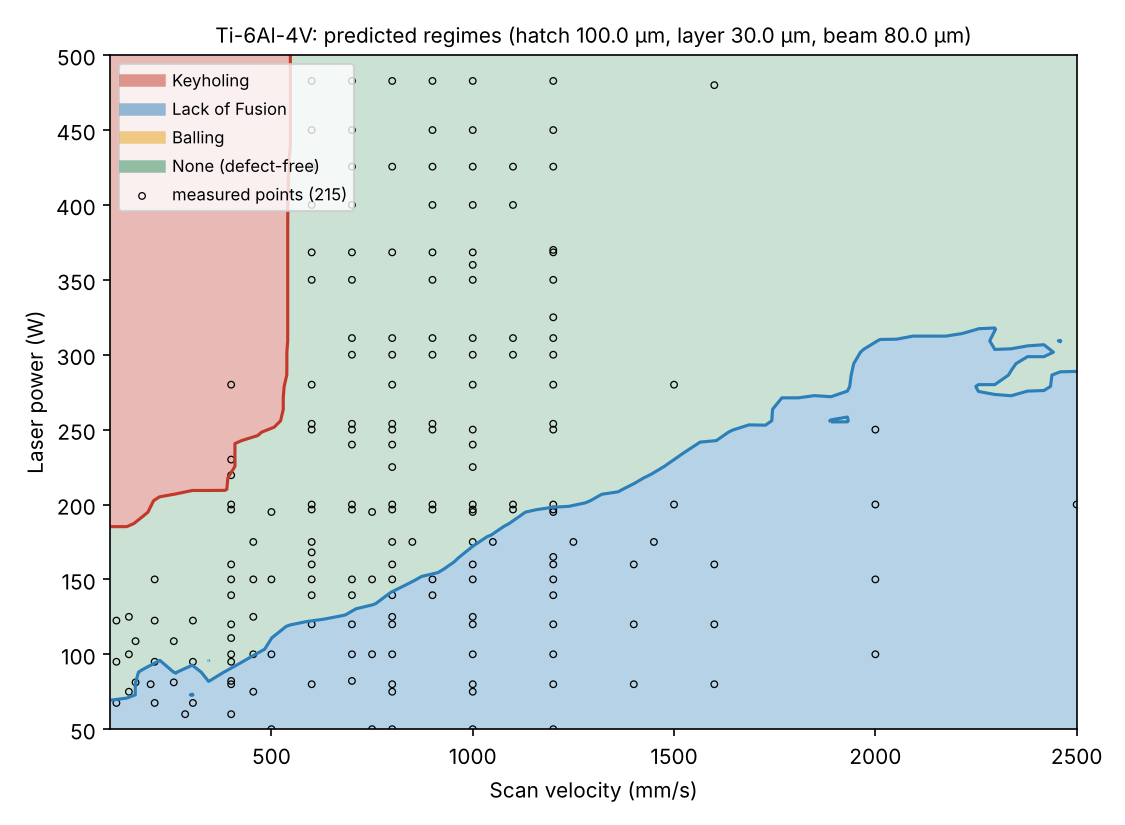
The map shows the textbook shape:
- keyholing at low speed and high power;
- lack of fusion below a line of roughly constant energy;
- a defect-free band between the two.
The most robust point is about 233 W at 870 mm/s.
Treat the map with care:
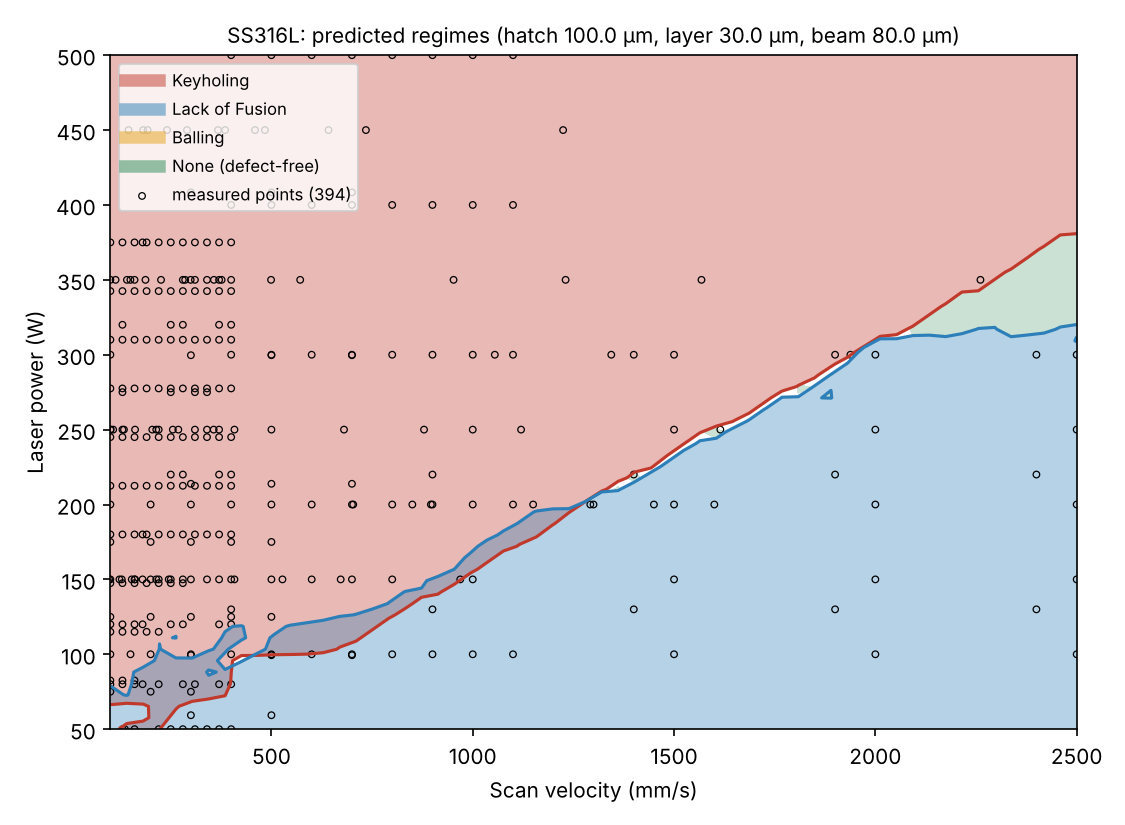
- Circles mark measured tracks for this alloy. Where there are none, the map is extrapolating.
- The criteria come from single tracks. For SS316L, many conduction-mode tracks have W/D < 1.5, so the map is conservative about keyholing:
5. Report it like an engineer
- Give the regime and probability, the energy density, and the physical lever:
- keyhole: lower P or raise v;
- LoF: lower hatch or layer, or raise energy;
- balling: reduce v at the same energy.
- Say whether the point is inside the measured data.
- Recommend single tracks and density cubes around the point. The model narrows the search; qualification still decides.
Cite: Pak & Barati Farimani, Addit. Manuf. Lett. 14 (2025) 100292; Akbari et al., Addit. Manuf. 55 (2022) 102817.