mechanical-engineering-skills
Tutorial: RocketSmith (design, check and print a hobby high-power rocket)
Skill: rocketsmith · Paper: P. Pak, J. Barkley, R. Loghmani, D. Baich, A. Pamal, A. Barati Farimani, RocketSmith: Agentic Additive Manufacturing of High-Powered Rockets, arXiv:2606.00097 (2026) · Code: ppak10/RocketSmith
RocketSmith designed four FDM-printed Class 2 rockets with OpenRocket, build123d/CADSmith and PrusaSlicer behind an LLM agent. All four launched stably at a Tripoli Pittsburgh event. Two were recovered reflyable, and the altimeter apogees were 80–84% of the predictions.
The paper’s lesson, which RocketBench also found: let tools compute every number and have the LLM orchestrate.
Scope. Airframes for certified commercial motors within your certification level (H–I need L1, J–L need L2). Motor, propellant, igniter and ejection-charge design are out of scope; follow the manufacturer and your Range Safety Officer.
Use cases
- Design for AM of rocket airframes: a consolidated fin can with an integrated motor mount, parts sized to your printer.
- Stability: CG and CP at liftoff and burnout, with fins sized to a target caliber.
- Flight prediction: apogee, rail-exit speed, thrust-to-weight, descent rate.
- Post-flight calibration: fit the airframe’s real drag from the altimeter.
Setup
npx skills add BaratiLab/mechanical-engineering-skills --skill rocketsmith
pip install numpy matplotlib cadquery
cd skills/rocketsmith
1. Check a design
examples/hp1_v38.json approximately reconstructs the paper’s High Power 1: 850 mm long, 101.6 mm
diameter, AeroTech H100W.
python scripts/rocket.py check examples/hp1_v38.json
| | This skill | Paper | |—|—|—| | Liftoff mass | 2268 g | 2249.8 g | | Stability, liftoff | 1.26 cal | 1.26 cal | | Stability, burnout | 1.38 cal | – | | Motor class | H (L1) | H (L1) |
All the checks pass.
How we got there: the first draft had 95 mm fins and stability 0.23 cal, an error. Moving the avionics forward and running
python scripts/rocket.py fins examples/hp1_v38.json --target 1.26 --out sized.json
widened the fin span to 162 mm, which is RocketSmith’s stability-analysis skill.
What the example is and isn’t. The fin span in hp1_v38.json is not taken from the paper: it
was sized with fins to reach the paper’s reported 1.26 cal. The stability match in the table is
therefore by construction. The flight comparison below, against the paper’s OpenRocket numbers, is
the check that was not tuned.
2. Predict the flight and compare with the paper
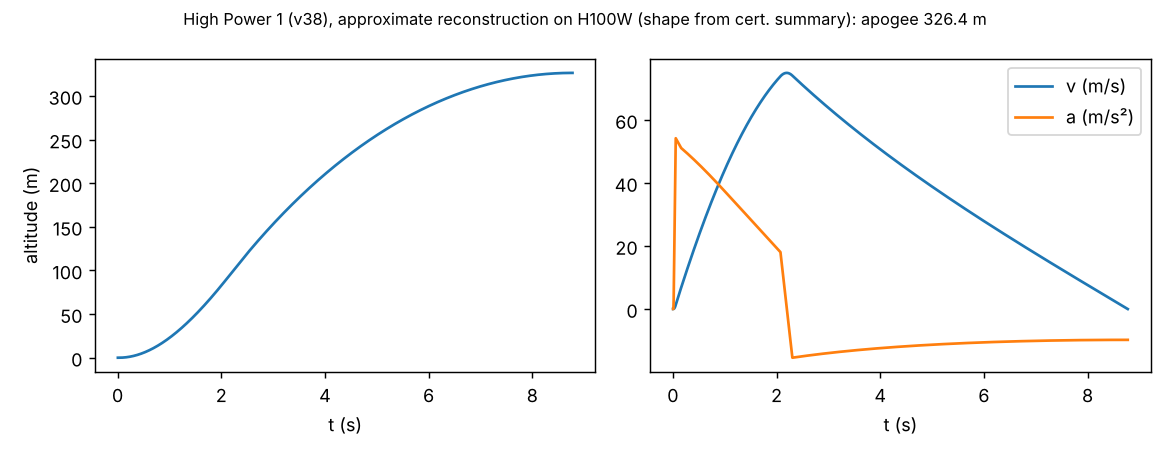
python scripts/rocket.py simulate examples/hp1_v38.json --cd 0.45 --plot hp1.png
| Apogee | Max velocity | Measured apogee | |
|---|---|---|---|
| HP1, this skill | 326 m | 75.0 m/s | 276 m |
| HP1, paper’s OpenRocket | 338.8 m | 76.4 m/s | |
| HP4 (J425R), this skill | 568 m | 113.7 m/s | 479 m |
| HP4, paper’s OpenRocket | 570.1 m | 115.2 m/s |
3. Learn from the flight
python scripts/rocket.py calibrate examples/hp1_v38.json --weighed "" --apogee 276      # Cd = 0.84
python scripts/rocket.py calibrate examples/hp4_big_heavy_2.json --weighed "" --apogee 479   # Cd = 0.76
The printed rockets flew with Cd ≈ 0.8, not the 0.45 that smooth airframes get. Printed surfaces, rail buttons, open slots and weathercocking all cost altitude. Use the fitted value for the next prediction.
4. Generate printable parts
python scripts/rocket.py cad examples/hp1_v38.json --out parts/
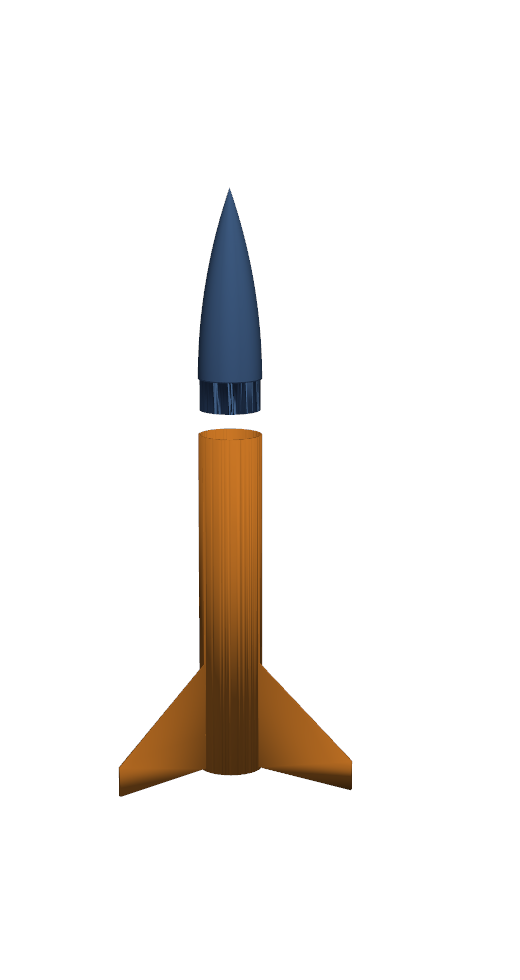
The output is an ogive nose cone with a shoulder, and a fin can with integrated fins and motor mount, as STEP and STL with mass estimates.
- Add pilot holes for shear pins, heat inserts and eyebolts on request (see
cadsmith-text-to-cad). - Print in PETG or ABS, not PLA, with 4–5 walls and 0.2 mm layers.
- Slice, weigh, and run
calibrate --weighed nose=...,fincan=...to re-check stability with the real masses.
Review checklist (from the paper’s flights)
- HP1: the eyebolt pulled out of the printed baffle and the lower airframe split. Anchor recovery to the motor mount or reinforce the baffle.
- HP2: the recovery bay didn’t separate, so it came down ballistic. Check shear-pin count and separation fit.
- Every design here is a candidate for review by the certified flyer and the RSO, never a launch approval.
Cite: Pak et al., arXiv:2606.00097 (2026).