mechanical-engineering-skills
Tutorial: StressD (geometry + loads → von Mises field, instantly)
Skill: stress-field-surrogate · Paper: Y. Jadhav, J. Berthel, C. Hu, R. Panat, J. Beuth, A. Barati Farimani, StressD: 2D stress estimation using denoising diffusion model, Computer Methods in Applied Mechanics and Engineering 416 (2023) 116343, doi:10.1016/j.cma.2023.116343
Topology optimization and generative design ask for thousands of stress fields. StressD answers each one in a fraction of an FEA solve. A conditional diffusion model draws the stress field normalised per sample, and a vision-transformer side network predicts the scale. On the standard cantilever benchmark, StressD cut MAE by about 78% compared with StressNet and StressGAN.
Use cases
- Screening shapes inside a design loop, then confirming the winner with FEA.
- Part-family surrogates: brackets, cantilevers, lattice cells; generate data with the built-in FEM or your solver.
- Teaching: how stress concentrates around holes and notches, live.
Setup
npx skills add BaratiLab/mechanical-engineering-skills --skill stress-field-surrogate
pip install numpy scipy matplotlib torch
cd skills/stress-field-surrogate
1. Make data you can trust
python scripts/stressd.py dataset --out cant.npz # 80 geometries x 72 angles x 20 magnitudes = 115,200 cases, ~20 s
- The data mirrors the paper’s cantilever set: 32 × 24 grid, left edge clamped, tip load at 0–355° and 5–100 N, in six geometry families.
- The plane-stress Q4 FEM matches beam theory within 1% on slender strips.
- Because the problem is linear, each geometry takes just 2 solves.
2. Train and test on shapes the model has never seen
python scripts/stressd.py train --data cant.npz --model regression --out reg.pt          # baseline
python scripts/stressd.py train --data cant.npz --model diffusion  --out sd.pt           # StressD
python scripts/stressd.py predict --model sd.pt --data cant.npz --out pred.npz --steps 50
python scripts/stressd.py metrics --pred pred.npz
python scripts/stressd.py plot --pred pred.npz --out cases.png
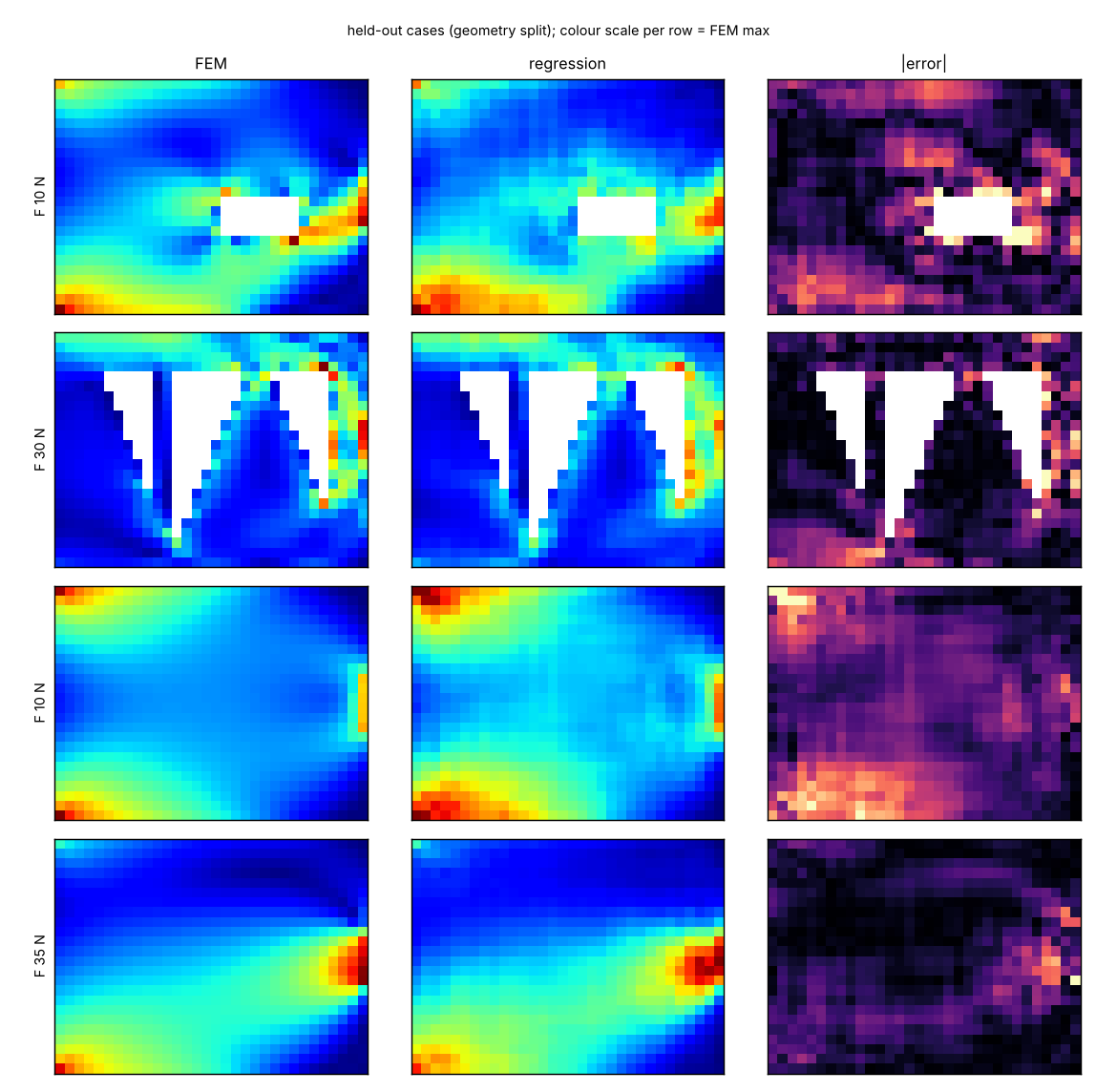
Results from a CPU rehearsal (a few epochs each, 30k training cases):
| Model, split | MAE (MPa) | Peak-stress error |
|---|---|---|
| Regression, random split (the paper’s protocol) | 0.57 | 11.1% |
| Regression, unseen geometries | 0.81 | 12.0% |
| Diffusion, unseen geometries (4 epochs) | 1.97 | 14.8% |
Mean true von Mises is about 5.5 MPa.
Why the split matters. The paper’s 80/20 random split shares geometries between train and test. Stress is linear in load, so a geometry the model has seen under other loads is nearly free to predict. Shapes it has never seen, the real design use, are harder; here 0.81 against 0.57 MAE at equal training. The skill defaults to unseen geometries.
The diffusion model needs much longer training than a CPU rehearsal: the paper reached MAE 0.04 after full GPU training. Train it to convergence before comparing.
In a design loop
Screen hundreds of candidates with the surrogate, keep the best few, and confirm them with real
FEA (quick-fea in this library). Report peak-stress error;
surrogates err most at notches and holes. Never take a safety factor from a surrogate.
Cite: Jadhav et al., CMAME 416 (2023) 116343.